
This article discusses a missed opportunity for a democratic secular Iran in 1979, due to the disease of Tehran-centrism, a “syndrome” of concentration of political decision making, media focus, and cultural privilege in Tehran, and other Fars majority cities in Iran, at the expense of peripheral areas, and later at the expense of the whole country; engulfing Iran in a totalitarian Islamic regime for 47 years.
The Iranian Revolution of 1979 took an Islamic turn in its final months. This Islamic character was solidified during the first year through a series of decisive events, including two undemocratic referendums, which Islamised the political structure of Iran.
This Islamisation did not even align with Khomeini’s stated positions during his time in Paris in 1978, before the Revolution. Yet two pivotal referendums transformed Iran’s trajectory: the first, in April 1979, asked whether Iran should become an Islamic Republic, offering only “Yes” or “No”—with a “No” effectively endorsing the return of the Pahlavi monarchy. The other one, in December 1979, approved a new Islamic constitution that formally established a theocratic rule under a powerful Supreme Leader.
Many secular, nationalist, and leftist revolutionaries later justified this outcome by claiming there was no alternative. But this article argues that an alternative *did* exist — one dismissed due to Tehran-centrism, a syndrome, and a political culture of deep centralisation in Iranian society and politics. This historical mistake was repeated 44 years later, during the Woman, Life, Freedom movement.
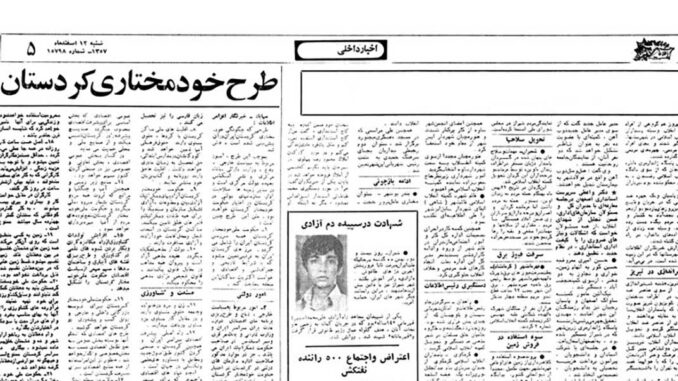
A 30-article Autonomy Proposal from the Kurdish Representative Council was published in Iran, a very progressive proposal that, for instance, emphasised secularism in its Article 10. This proposal was published in the Etelaat newspaper on the second of March 1979 (12 of Esfand 1357 in the Iranian calendar). The photo is from the Newspaper.
In 1979, the alternative was visible both geographically, in Kurdistan, and also in the official press, in Tehran and all other major cities.
In Kurdistan, unlike other regions of Iran, the revolution was not led by clerics. Instead, leftist and democratic political parties led the uprising, enjoying broad popular support. During the revolutionary days of 1979, Kurds united around secular, democratic, and egalitarian demands, encapsulated in the slogan: Democracy for Iran, Autonomy for Kurdistan. Kurdish leaders framed their struggle through nationalism, egalitarianism, and democracy — not Islamism. Secularism was seen not as a threat, but as a guarantee of peaceful coexistence.
This alternative was not hidden in Tehran. The proposal for this alternative appeared in Etelaat, the largest state-run newspaper published in Tehran and distributed across Iran. On the second of March 1979 — just three weeks after the revolution and four weeks before the referendum — the paper published an autonomy proposal formulated in 30 articles. Article 10 explicitly called for the separation of religion and state, affirming freedom of belief and equality among all religions. At a time when Khomeini was emerging as a charismatic figure for some Iranians, and others remained silent, this proposal was an obvious alternative.
Crucially, this was not a local or party publication. It was published in a national, official newspaper. The proposal addressed two major concerns about autonomy, and also provided four alternative options for Islamic governance. Now, we must take a look at some other aspects of this progressive alternative:
Regarding autonomy
1. Unity vs Separation: It clearly stated that autonomy did not mean independence. Article 2 of the proposal stated that all policy-making regarding defence, foreign policy, and major financial planning remained under the control of the central government.
2. Language: Article 7 clarified that Farsi would be taught starting in the fourth year of schooling, and Article 24 affirmed that the Persian language and its literature would be supported and flourish in Kurdistan.
Regarding Democratic Alternatives to the Islamic Republic:
Articles 4 and 11 guaranteed gender equality and minority rights in contrast to the current gender apartheid in Iran.
Article 10 emphasises secularism: the separation of religion and state, freedom of religious belief, and legal equality for all religions, and condemns racial and religious discrimination, in sharp contrast to the current situation in Iran.
Article 9 protected democratic freedoms — freedom of speech, the press, and the right to form civil organisations and unions.
And finally, Article 29 regarding Iran’s regional and global policies promoted global peace and peaceful coexistence, advocating conflict resolution through the United Nations rather than the idea of exporting the revolution at the expense of current regional conflicts.
In this autonomy proposal, not only were the obscurities and accusations surrounding autonomy and its differences with separation addressed, but a democratic alternative was also proposed to counter the Islamic Republic’s extremist policies. In other words, this proposal did more than clarify misconceptions about autonomy—it offered a coherent democratic alternative to the emerging theocratic governance. Yet, Persian and non-Kurdish intellectuals, along with their secular revolutionaries, ignored it, mostly because it was presented from a peripheral region of Iran, and the centrist political culture of Iran was unable to accept that.
Rooted in a centralist syndrome, they missed or dismissed a vision from Kurdistan. Forty-four years later, the same mistake was repeated, during the Woman, Life, Freedom movement — a movement, born in Kurdistan but instead of embracing its radical democratic potential, centrists and monarchists reframed it as mard mihan abadi, something as Man, Homeland, and Settlement, diverting this progressive movement from its original path.
Despite this marginalisation — which ultimately harms the whole Iranian opposition— the Kurdish movement has remained the most politically advanced in Iran today. The Kurds are the only people in Iran who are politically organised and can, for instance, launch general strikes across more than 50 Kurdish cities. The latest one was in January 2026. At the same time, Kurdish political parties are not only active and popular but can also form coalitions and act collectively. In contrast, much of the rest of Iran still lacks even basic political organisation, let alone cooperation.
These historical events were not just historical footnotes—they were missed opportunities. If Iran’s revolution had embraced pluralism, secularism, and decentralisation of this Kurdish alternative, its fate would have been entirely different. To solve Iran’s ongoing political and social crises, including the newly emerged ultra-right semi fascist movement, this deep-seated disease of Tehran, centrism and Fars-centrism must finally be confronted.