
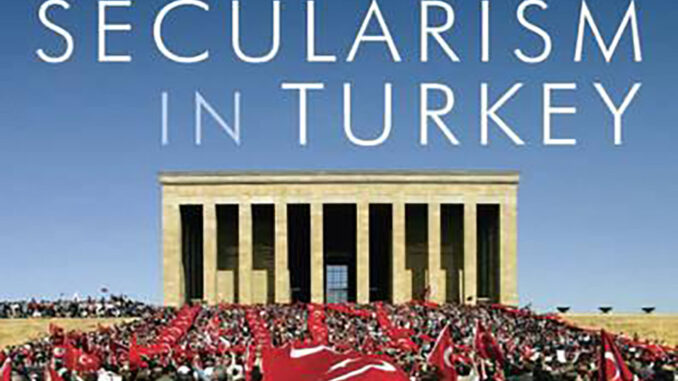
There are many similarities between the process of secularism and its failure in Turkey and the same process in Iraq, Syria and Iran. In all cases, secularism was intertwined with nationalism in an authoritarian framework, which finally failed to obtain its goals and its failure led to the rise of political Islam. However, in the case of Turkey, its nationalism was not imported from outside and was not imposed by a colonial power. Turkish new nationalism emerged as a reaction to the defeat of old nationalism. In addition, Islam was to blame for the collapse of the Ottoman Empire, given it was an Islamic polity that, according to the new Turkish nationalists, was the reason for its defeats. Thus, its secularism was also a choice by its new rulers.
The new rulers started by changing the Islamic calendar to the Gregorian calendar, introducing the Latin alphabet, imposing a Western-style system of civil law, and, most notably, abolishing the Caliphate. Also, the centralised nation-building process put increasing pressure on non-Turkish ethnic and religious groups.
To understand a newly established republic that can quickly turn into a republican tyranny, one must examine the political environment created after the collapse of the Ottoman Empire. Following the end of WWI, the officers of the former empire had been trying to turn back the clock a bit to the previous state and reduce Ottoman losses. Mustafa Kamal, later Ataturk, emerged as the military leader of a national movement in 1922. He wanted to change not only the quantity but also the quality of the remaining Ottoman polity by imposing modern ideas. He found Westernisation to be the critical factor for this revival process. Ataturk wanted to achieve a great deal in a very short period, and such an ambitious plan required exceptional political conditions: for about 15 years, Ataturk became the absolute tyrant of Turkey.
The difficulties of the new nation-building process were not limited to Ataturk’s style of governance and its single-person rule. Still, the way of launching an extreme version of secularism in a Muslim-majority country made the process more complicated. It was a rapid, top-down, state-led ‘borrowed’ process from the West, even more potent than its Western version. This extremism was characterised by a personal rule without effective regulations, in contrast with the spirit of modernity. Turkish politics still suffers from personalisation and militarisation, a legacy from Atatürk that has existed for a hundred years.
In this page the authors will explain why nationalism could not be inclusive in making a unified nation-state but excluded many residents of the new Turkey, mainly the Kurds. They also discuss the reasons for its secularism failure, in which political Islam became a source of conflict with secularism, and now it has been more than two decades since an Islamic political party, AKP, has been the ruling party in Turkey