
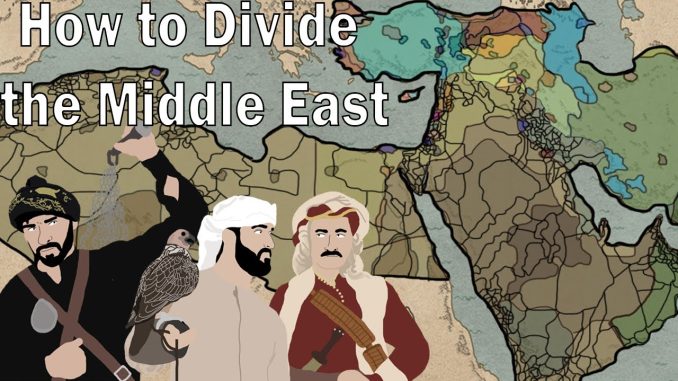
Our project contributes to understanding the origins of conflicts in the Middle East, intending to establish a better future. There has been significant debate about the reasons for these conflicts and the absence of democratic systems in the region. Some scholars argue that cultural and religious factors have explained this democratic deficit for thousands of years. Others emphasise the lack of a social development process that would have led to modernisation and democratisation, as seen in the West since the 17th century. A third group believes that much of the Middle East’s current social and political situation is rooted in events from the last 100 years, particularly since 1918. These events include the creation of states and borders by Europeans, the establishment of Israel, the rise of oil as a key factor in the international political economy, and the influence of colonial and superpower interventions. Our project approves the third approach.
Samuel Huntington, in his seminal work “The Clash of Civilizations,” and Bernard Lewis, in “What Went Wrong? The Clash Between Islam and Modernity in the Middle East,” are two prominent scholars who attribute the source of conflict in the region to religion. Ironically, Islamic radical leaders like Khomeini and bin Laden echo this sentiment, claiming that the roots of the conflict extend back thousands of years. However, none of these perspectives offers a solution beyond defeating the opposing side. Political Islam was not the initial preference of the people in the region. Throughout the twentieth century, the failures of various modern ideologies, including secularism and nationalism, since 1918 compelled many individuals to turn toward Islamism as the only remaining option.
These four countries began their modernisation processes along the lines of secularism in the early 1920s. Even during the mandate period and before gaining independence, nations like Syria were established on secular principles. In her recent works, Elizabeth Thompson demonstrates that the Syrian Arab State, formed in 1920, along with its Syrian National Congress, had a secular constitution that emphasised equality for all Arabs, regardless of religion. However, Thompson tends to exaggerate the political circumstances of that time. In her work, “How the West Stole Democracy From the Arabs,” she claims that the Arabs established a democracy in Syria. In this so-called ‘democracy,’ the rights of non-Arabs were not addressed. What was truly lost was secularism, not democracy. Overall, it’s reasonable to conclude that all four countries have failed for various reasons, merging secularism with totalitarianism, dictatorship, and a single-party system, whether in republican or monarchical forms. A significant factor in this failure has been the negative influence of external powers, which has indirectly contributed to the rise of political Islam.
Some scholars swing between extremes in examining the roots of authoritarianism and conflict in the Middle East. Fawaz Gerges, in his book “What Really Went Wrong: The West and the Failure of Democracy in the Middle East,” focuses on the Cold War era and argues that events such as the American-backed coup in Iran in 1953 and U.S. conflicts with Egypt in the mid-1950s sowed the seeds of later discontent and conflict. While I agree with Gerges about the adverse effects of superpower policies in the region, we believe that attributing the roots of conflict solely to the Cold War overlooks the mistakes made by former empires since 1918, some four decades before the Cold War began. The roots of the conflict are not ancient, nor are they confined to the second half of the twentieth century. We contend that the pivotal moment for significant socio-political errors in the Middle East was 1918. In discussing the Syrian National Congress, Gerges also makes an unverified claim: that it approved a liberal democratic constitution ensuring the rights of all people—Muslims and non-Muslims, Arabs and non-Arabs. This assertion is inaccurate. The constitution was neither liberal nor democratic and did not recognise the rights of non-Arabs, even though it avoided the term ‘non-Arab.’ It was secular but not liberal or democratic. Thus, we reiterate that the Middle East’s modernisation efforts began within a secular yet undemocratic framework. Focusing on the contemporary politics and social changes help us to find a parctical remedy for the current problems.