
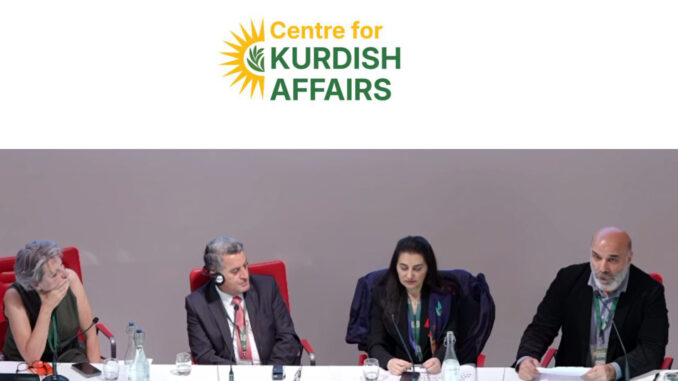
Centre for Kurdish Affairs, an independent research centre based in London, launched the Peace and Democratic Integration Conference on 29-30 September 2026 to discuss different aspects of peace negotiations in Turkey.
Hemn Seyedi, the co-founder of the Middle East Institute for Democratic Developments, was invited to present his view regarding the peace process in Turkey from a Rojhelat (Kurdistan of Iran) perspective. Here is the text of his speech:
The video is also at the bottom of this page.
‘Hello everyone, and thank you — to the panel, to the audience, and especially to the team at The Centre for Kurdish Affairs, who organised this vital conference.
You’ve been kind enough to introduce me, but there’s one thing that wasn’t mentioned: I’m from Rojhelat, also known as Eastern Kurdistan, or Kurdistan of Iran, and today I will speak through that lens, offering an insider perspective from Iran on the broader Kurdish struggle for peace, democracy, national rights and integration.
I’ll begin with a brief report on the current situation in Rojhelat.
Then, I’ll examine Rojhelat’s place in Iran’s political landscape, Rojhelat’s ties to other parts of Kurdistan, and also its historical memory of peace negotiations.
I’ll also share our hopes for a democratic resolution in Turkey, and beyond that, the integration of our kin into Europe, and what it would mean for Rojhelat to become a European-facing border region.
Finally, I’ll offer a few suggestions from Rojhelat’s vantage point.
Rojhelat is the birthplace of modern Kurdish nationalism. For over eighty years, Kurds in Iran have fought for their national rights; they have a variety of political parties, a rich political ecosystem, a strong grassroots organisation, and a public that trusts its leaders. Yet, despite the Kurds now being the leading nation in Iran, even beyond Kurdistan, the reality remains that the Islamic Republic still refuses to recognise Kurdish rights, not even to the minimal extent that exists in the current Syria. For forty-seven years, Kurdish political parties have been in armed resistance against this regime.
In recent years, Kurdish political strength has drawn attention from non-Kurdish people in other regions of Iran. Those in central regions of Iran, without their own party structures, are surprised by the power and discipline of the Kurdish political system. They also suffer from a lack of political coordination, yet admire the high level of organisation and political awareness among Kurds in Kurdistan.
Unfortunately, they still have to pay for the errors, missteps and lack of experience of Iranian opposition leaders abroad. It was clear in January this year that thousands—or perhaps tens of thousands—of people were killed in Tehran and other central regions of Iran when Reza Pahlavi called for mass protests, with no preparation.
At that very same time, responding to a call from Kurdish parties, the people of Kurdistan launched a general strike, spread across 51 cities in Rojhelat, and not a single life was lost. The most recent strike was just two weeks ago, on 16th of September, marking the fourth anniversary of Zhina Amini’s death. Once again, the people of Rojhelat went on strike—peaceful, powerful, and respectful of their political leadership.
The Kurdish people in Rojhelat do not just organise at home, but stand with their kin across Kurdistan, in Turkey, Iraq, and Syria— and, alongside offering support, they also participate to the best of their ability. For over three decades, many Kurds in Iran have supported the PKK and the Kurdish movement in Bakur (Turkey’s Kurdistan); hundreds of Kurds from Iran have joined the PKK, and many faced detention and torture.
In 2004, PKK members from Rojhelat founded PJAK, the pro-PKK political party that formally organised the PKK’s ideology in the region, boosted the Kurdish struggle in Rojhelat alongside other Kurdish political parties, and created a political force that remains central to the Kurdish struggle there.
The same applies to Bashur, or Iraqi Kurdistan: Kurds in Iran support the Kurdistan Regional Government and its people; their solidarity is mostly cultural and intellectual. Many Kurds from Iran have taught in universities, published books, and worked in the media in Bashur. The public in Rojhelat has celebrated every milestone in Bashur—from Jalal Talabani’s selection as Iraqi President and the declaration of federalism to providing public aid for displaced people from Shangal.
Most notably, following the Kurdistan independence referendum in September 2017, hundreds of thousands of people took to the streets across Rojhelat to celebrate. It was like a semi-referendum — a powerful statement of shared aspiration.
This cross-border support also extended to Rojava, both politically and physically. The Kurds in Iran fully supported the Kurdish struggle in Syria; many Kurdish youth joined the ranks of the People’s Protection Units (YPG) and Women’s Protection Units (YPJ), and they also marched on the streets in solidarity with Kobanî and Rojava. They saw — and lived — the unity of struggle for Kurdish rights.
Turning to the current situation, however, Kurds in Iran are extremely sensitive and sceptical regarding negotiations with the government—a stance rooted in their specific historical experiences with such politics. That scepticism is not abstract. It is written in blood.
Simko, 1930, was killed just minutes after negotiating with Iranian officials.
Qazi Muhammad, 1947, was executed after having accepted terms of negotiation and voluntarily surrendering himself to the Shah’s army.
Dr Ghassemlou, 1989, was assassinated at the negotiating table in Vienna;
Dr Sharafkandi, 1992, was killed during negotiations with Iranian opposition in Berlin.
The most recent talks between Kurdish political parties and the Islamic Republic took place in Oslo in 2019; it was less negotiation than intimidation — a show of threats, not dialogue.
And yet, Rojhelat watch Turkey with cautious hope.
The Kurds in Iran remain optimistic about the future of negotiations in Turkey; in many respects, they view the Turkish government as more serious and better suited to negotiating than the Iranian government. They believe that resolving the Kurdish question in Turkey—home to half of the Kurds in the world—could also open the door for a solution in Iran. They further hope that as these negotiations progress and Turkey develops its democratisation, the country will join the European Union. In such a scenario, not only more than twenty million Kurds become European citizens, but *Rojhelat* in Iran, today a borderland of repression, could become a neighbour and gateway to Europe.
So what can be done? In conclusion, I offer a few suggestions regarding the Kurds in Iran and the ongoing negotiation process in Turkey.
First, do not replicate the Turkish model in Iran or attempt to apply it directly to the Kurds in Rojhelat. The political realities are too different. The structure of the Iranian regime — theocratic, religious, repressive — is not comparable to Turkey’s. Rojhelat’s struggle, its political parties, and its people — require a different approach.
Second, do not instrumentalise PJAK. It is not a proxy. Any attempt to use PJAK as a tool to interfere in Iran’s political landscape would be dangerous. PJAK is currently a legitimate political party in Iranian Kurdistan and a key founding member of the Alliance of Iranian Kurdish Forces—a coalition of six Kurdish political parties formed in February after years of dialogue and compromise. This Alliance has drawn significant attention inside Iran and beyond. PJAK is a pillar of it — not a branch of the PKK, but a homegrown force with deep roots in Rojhelat.
Third: Invest in the Woman, Life, Freedom movement — Jin, Jiyan, Azadi. Born in Bakur from Öcalan’s philosophy, it was not just embraced in Rojhelat — it became the engine of Iran’s 2022 revolution. For the first time, a Kurdish political philosophy has become a national rallying cry. It is now the ing, unifying ideology in Iran—led by the Kurds —and can be considered the ideology of the new Middle East.
We have not seen this level of cross-national, cross-regional acceptance in Iraq, Turkey and Syria so far, but now it is the only existing and potential ideology in Iran; it is real. It is alive. It’s worth investing in it and paying closer attention to have it spread beyond Kurdistan and Iran. It could be the foundation of a new Middle East.
Finally, watch Rojhelat! Follow the events unfolding in Rojhelat and Iran. Kurds in Iran are currently playing a pivotal role. The Iranian people have come to recognise that Kurdistan is ahead of other regions in political organisation, experience, and resistance, and that this region will play a crucial role in Iran’s future political developments.
With its geography, population, resources, and strategic position, Rojhelat is the second-largest region in Kurdistan. We will likely hear a great deal about Rojhelat in the coming weeks and months; its voice will only grow louder.
Thank you for listening. I wish every success to the peace process in Turkey, not just for our kin there, but for all of us, everywhere, who dream of a free, democratic, and united future’.